
Lablup Gathers Nine Companies and Institutions, Including Global Chipmakers and a U.S. Customer, at Its SC26 Booth for the Fourth Consecutive Year

- Nine companies and institutions present at the Lablup booth, including three global chipmakers (AMD, Intel, and NVIDIA), three Korean NPU companies, infrastructure partners, and U.S. customer USC
- Lablup presents its strategy for the token factory era, from hardware-agnostic heterogeneous infrastructure integration with Backend.AI to LLM operations on air-gapped financial networks
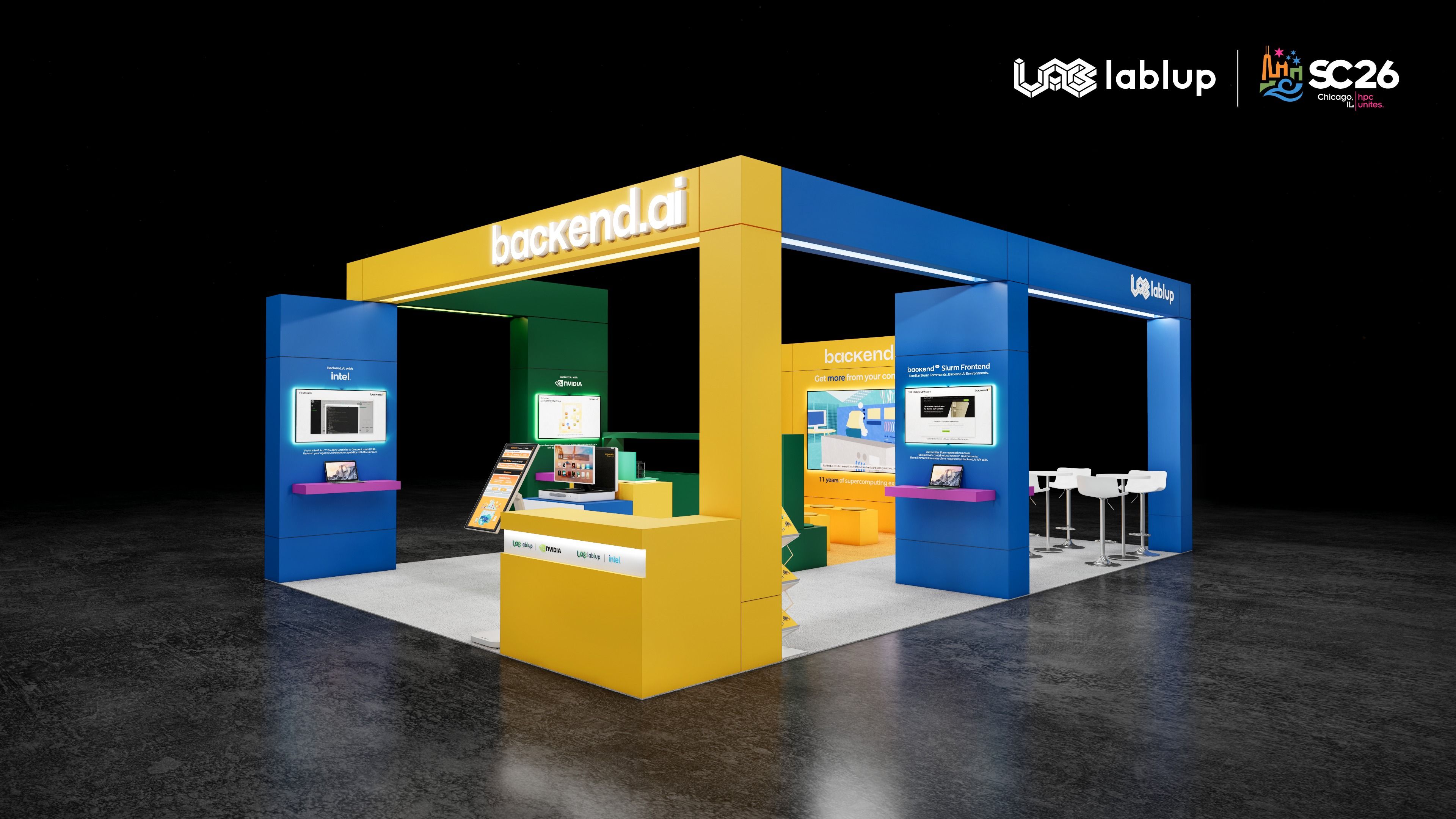
▲ Rendering of Lablup's booth at SuperComputing 2026 (SC26)
Lablup (0147B0, CEO Jeongkyu Shin), an AI infrastructure software company, will exhibit at SuperComputing 2026 (SC26), opening on November 17 (local time) in Chicago, where it will showcase next-generation AI infrastructure operations technology alongside global AI chip companies.
SC26 is a global event covering advanced computing technologies, including high-performance computing (HPC), AI, networking, and storage. This year's exhibition runs from November 17 to 19 at McCormick Place in Chicago. Lablup is exhibiting for the fourth consecutive year and will host Booth 4630. The company plans to expand its technical collaboration with global AI chip and infrastructure companies and strengthen its position in the global market as an AI infrastructure software company.
Lablup will host "Booth Talks," a program of technical presentations by leading companies and institutions from Korea and abroad. A total of nine companies and institutions will present at the Lablup booth: global chipmakers AMD, Intel, and NVIDIA; Korean NPU companies Rebellions, FuriosaAI, and HyperAccel; infrastructure partners AMAX and VAST Data; and the University of Southern California (USC).
AMD and NVIDIA will deliver technical presentations, and Intel will share how to build agentic AI infrastructure in an open, heterogeneous computing environment. From Korea, Rebellions will present on operating large-scale AI services on NPUs, and FuriosaAI will share a case study on LLM operations and power efficiency that pairs its AI accelerator "RNGD" with Backend.AI. HyperAccel will introduce AI infrastructure technology focused on token efficiency.
The program also features real-world customer deployments and partner presentations. BD Kim of USC will present "Delivering AI Computing as a Service with Backend.AI for Academic Research," a real-world case of delivering AI computing resources as a service to university researchers. Lablup will also share how CJLab at the Korea Institute of Science and Technology (KIST) used Backend.AI Cloud to accelerate its research on the Cas9 gene-editing mechanism and gained a research environment it can access from anywhere. Partner AMAX will share approaches to adopting on-premises AI, and VAST Data will join Lablup to present KV cache optimization strategies.
At the event, Lablup will present how to operate a "Token Factory" in a talk titled "You Built the Token Factory. Who Runs It?" The token factory concept treats AI data centers as factories that produce tokens, the output of AI model inference. In a second talk, "From GPU Cluster to Token Factory: Running LLM in an Air-Gapped Financial Network," Lablup will share how to run LLMs on an air-gapped financial network. Lablup will show how its AI infrastructure management platform "Backend.AI" runs different AI accelerators and computing resources in a single environment, and how "Continuum Enterprise" provides unified management of everything from AI model request handling to token usage, operating policies, costs, and billing. The company will also showcase "AI:GO," a desktop application that runs AI models directly on a personal PC without a cloud server, along with "Full-stack Observability" technology across the entire AI infrastructure.
Lablup will also introduce "Slurm Frontend," which lets users keep using commands from Slurm, an established HPC job management tool, while running jobs in Backend.AI's container environment. In addition, the company will present "Confidential AI," a technology that protects sensitive data and AI models within a hardware-based trusted execution environment (TEE).
"As AI infrastructure expands across diverse chips and computing environments, software that can efficiently integrate and operate them is becoming increasingly important," said Jeongkyu Shin, CEO of Lablup. "At SC26, where a wide range of AI chip technologies come together in one place, we will showcase the scalability of Backend.AI and our strategy for unified operations, and actively respond to an AI infrastructure market that is evolving around token production and operational efficiency."


