Lablup presents an AI infrastructure operations case study at the UN AI for Good Global Summit 2026

- Invited as workshop speaker through NIPA recommendation; highlights the importance of cross-stack optimization for large-scale AI infrastructure
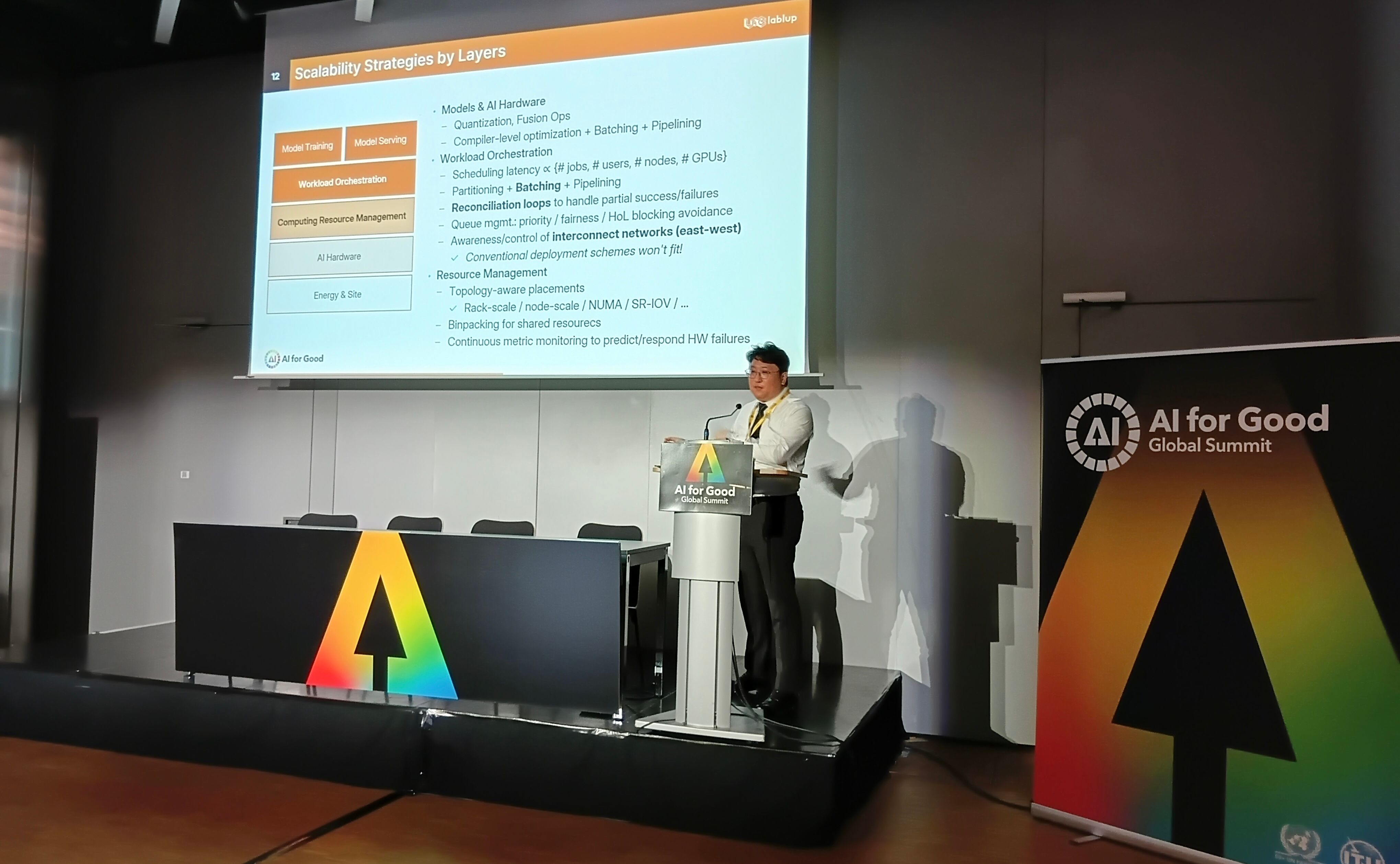
Lablup (CEO Jeongkyu Shin), an AI infrastructure platform company, presented its large-scale AI infrastructure operations at the AI for Good Global Summit 2026 hosted by the International Telecommunication Union (ITU), a United Nations specialized agency. The company announced on July 11 that it had been invited as a workshop speaker at this year's summit after conducting regular meetings with the ITU since early this year, following a recommendation from the National IT Industry Promotion Agency (NIPA).
The AI for Good Global Summit is the world's largest UN event on artificial intelligence, co-organized by the ITU together with the Swiss government and more than 50 UN agencies. Now in its seventh year, the event was held from July 7 to 10 at Palexpo in Geneva, Switzerland, drawing over 12,000 participants from 170 countries and setting a new attendance record. The summit focused on three core themes: AI standards, universal AI capacity building, and AI governance, bringing together representatives from governments, enterprises, academia, and international organizations.
On July 7, the opening day of the summit, Lablup CTO Junki Kim delivered a 15-minute session presentation at "The Future of AI Native Communication Networks," a workshop organized under ITU-T Study Group 13 (Future Networks and Emerging Network Technologies). SG13 is a study group dedicated to the convergence of telecommunications networks and AI technologies. The workshop addressed both the "AI for Network" perspective, which focuses on enhancing network operations through AI, and the "Network for AI" perspective, which examines how networks must evolve as infrastructure to support large-scale AI workloads.
In his presentation, CTO Kim emphasized that as AI infrastructure grows in scale, the critical challenge is shifting from single-GPU performance to cross-stack optimization that spans hardware, software, and networking layers. As AI model training expands to clusters of hundreds of GPUs or more, achieving meaningful efficiency requires integrated design and operation across the entire stack, including scheduling, storage, and network segments, rather than optimizing individual components in isolation.
Kim shared a real-world case from the "Sovereign AI Foundation Model" project led by the Ministry of Science and ICT of South Korea. As the infrastructure partner within the Upstage consortium, Lablup operated a training cluster of over 500 NVIDIA B200 GPUs on its Backend.AI platform, achieving results such as a 47% reduction in failure recovery time and minimized training time loss. CTO Kim provided a detailed account of the fault-tolerant scheduling strategies and failure recovery techniques accumulated through this process.
"In large-scale AI training environments, overall performance depends more on how the entire stack is designed and operated than on the performance of any single GPU," said CTO Kim. "This presentation gave us the opportunity to share infrastructure engineering experience validated in production within the context of international standardization discussions."
During the summit, CTO Kim also attended other SG13-organized workshops, including "Agentic AI: Architecture and Standards for Next-Generation AI Agents" and "Advancing AI in Networks," to gain insight into trends in AI agent adoption for telecommunications networks and ongoing standardization discussions. These sessions also featured updates on AI standardization activities from global telecom operators such as NTT, China Mobile, and Orange.
Building on this summit, Lablup plans to pursue follow-up collaboration with the ITU and contacts established on-site. The company intends to explore ways to contribute to international standardization efforts in the field of AI infrastructure engineering.
Backend.AI, developed by Lablup, is an AI infrastructure operations platform that manages heterogeneous AI accelerators from NVIDIA, AMD, Intel, and others within a single unified platform. Through container-level GPU virtualization and a proprietary orchestrator, it maximizes GPU utilization and reduces infrastructure operational complexity. Lablup currently provides Backend.AI to customers across Asia, North America, and the EMEA region.