
Lablup Sets Sights on Becoming a Global AI Software Company with Technology to Optimize AI Infrastructure Operations

- A full-stack AI infrastructure operations platform integrating GPU and NPU resource management, AI training, inference and serving, and agent and token operations
- Proven efficiency and stability at scale, with a 2.8-fold improvement in GPU utilization and more than 2,000 GPUs managed at a single site
- A land-and-expand growth model with 94.7% recurring revenue and 131.9% net revenue retention, supported by international expansion targeting global neocloud providers and leveraging reseller networks
SEOUL, South Korea, October 19, 2026 — Lablup, an AI infrastructure management and operations software company led by CEO Jeongkyu Shin, held an IPO briefing on October 19, attended by its CEO and employees, to present its growth strategy and vision following its planned KOSDAQ listing.
Founded in 2015, Lablup specializes in software that helps organizations design and operate AI infrastructure efficiently. Its flagship platform, Backend.AI, integrates the entire AI infrastructure lifecycle into a single platform, from managing AI accelerator resources such as GPUs and NPUs to AI model development and training, inference and serving, and agent and token operations.
Lablup differentiates itself through two core strengths: its proprietary full-stack technology and operational expertise accumulated across more than 120 sites over 12 years. Its proprietary technologies include GPU partitioning and virtualization, an AI workload orchestration engine, storage virtualization, and enterprise inference serving, all developed through early investments that predate the widespread adoption of AI. The company has translated its experience addressing recurring failures and resource inefficiencies in large-scale AI systems into product capabilities. Backend.AI supports more than 11 types of AI accelerators, including GPUs from NVIDIA, AMD, and Intel, as well as Korean-developed NPUs, across on-premises, cloud, hybrid, and air-gapped environments.
This operational track record is reflected in results across real-world deployments. Backend.AI is deployed at more than 120 sites in Korea and abroad, including major enterprises and institutions such as Samsung Electronics, Hyundai Mobis, kt, kt cloud, Shinhan Bank, and Samsung Medical Center. The platform supports stable operations for more than 2,000 GPUs at a single site. Deployments have demonstrated an approximately 2.8-fold improvement in GPU utilization, from 30% to 85%, and a 40% reduction in GPU spending.
Lablup has also demonstrated its ability to support large-scale AI operations as the infrastructure partner for the Upstage consortium in the Korean government's sovereign AI foundation model project. Working with Upstage, Lablup has shortened GPU failure response times to improve model training efficiency. From the project's first phase to the present, the company has supported stable training of sovereign AI foundation models across a cumulative total of more than 2,500 NVIDIA B200 and H100 GPUs, demonstrating the efficiency and reliability of its AI infrastructure operations.
Partnerships with global AI infrastructure companies are another competitive strength. Lablup has maintained a relationship with NVIDIA for more than eight years, beginning with its receipt of the AI Conference Inception Award in 2018. In 2021, Lablup became the first company in the Asia-Pacific region to be named an NVIDIA DGX-Ready Software Partner. It has also participated in NVIDIA GTC as a Silver Sponsor for three consecutive years, from 2024 through 2026. Lablup conducts joint AI accelerator performance validation with Intel and was recently named an ecosystem partner for Intel's GPU D-Series, code-named Crescent Island, at the 2026 OCP Global Summit. These global partnerships support the company's continued focus on research and development. Lablup is also working with VAST Data on joint engineering initiatives to optimize AI inference, further strengthening its position in the global AI ecosystem.
Another strength is Lablup's business model, which is built on a stable recurring revenue base. The company operates an annual subscription-based land-and-expand model in which customers' GPU capacity expansion, upgrades to next-generation GPUs, and broader adoption of AI generate additional license revenue. Recurring revenue accounted for 94.7% of total revenue in 2025, while average net revenue retention (NRR) over the past two years reached 131.9%.
Building on its technology and business foundation, Lablup plans to accelerate its expansion into the global AI infrastructure market following its listing. The company will target global neocloud providers as a key customer segment, responding to growing demand for sovereign AI as countries seek to secure data sovereignty and build independent AI infrastructure. It also plans to strengthen its global presence through local reseller partnerships in markets including the United States, the United Kingdom, and Singapore.
Lablup is also expanding its product portfolio to address changes in the AI industry. The company has developed AI:GO, extending its AI infrastructure operations capabilities beyond data centers to edge environments such as PCs and workstations. It has also introduced Continuum Suite, which combines multi-model routing and token management. The suite consists of Continuum Router, which centrally manages multiple AI models and routes requests to the most suitable model, and Continuum Hub, which manages AI token usage and costs. Through these offerings, Lablup is expanding beyond GPU resource management into broader AI service operations. The company plans to bring these capabilities together in Lablup Token Factory Suite, a platform supporting AI infrastructure operations, model inference, and token usage and cost management.
Lablup plans to use the proceeds from its listing to advance research and development, expand its global business, and strengthen its infrastructure. In particular, the company will broaden Backend.AI's support for an increasingly diverse ecosystem of GPUs, NPUs, and other AI accelerators, while accelerating its expansion into North America, Japan, Southeast Asia, Europe, and the Middle East.
“Over the past decade, Lablup has demonstrated its technological competitiveness through proprietary AI infrastructure operations technologies and collaboration with global companies,” said Jeongkyu Shin, CEO of Lablup. “Our KOSDAQ listing will provide a foundation for accelerating our global expansion and extending our business beyond GPU infrastructure management to AI model and token operations, as we grow into a global AI infrastructure software company.”
Lablup plans to offer a total of 2,180,000 shares at an indicative price range of KRW 19,000 to KRW 22,000 per share, with expected gross proceeds of KRW 41.4 billion to KRW 48.0 billion. Institutional bookbuilding is scheduled for October 13 to 19, followed by retail subscriptions on October 22 and 23. NH Investment & Securities is the lead underwriter.
Tentative IPO Schedule
| Milestone | Date |
|---|---|
| Initial Securities Registration Statement Filing | August 25, 2026 |
| Institutional Bookbuilding | October 13 to 19, 2026 |
| Retail Subscriptions | October 22 to 23, 2026 |
| Planned KOSDAQ Listing | November 3, 2026 |
Offering Overview
| Item | Details |
|---|---|
| Shares to Be Offered | 2,180,000 shares |
| Indicative Offer Price per Share | KRW 19,000 to KRW 22,000 |
| Expected Gross Proceeds | KRW 41.4 billion to KRW 48.0 billion |
| Total Shares to Be Listed | 14,544,139 shares |
| Implied Market Capitalization | KRW 276.3 billion to KRW 320.0 billion |
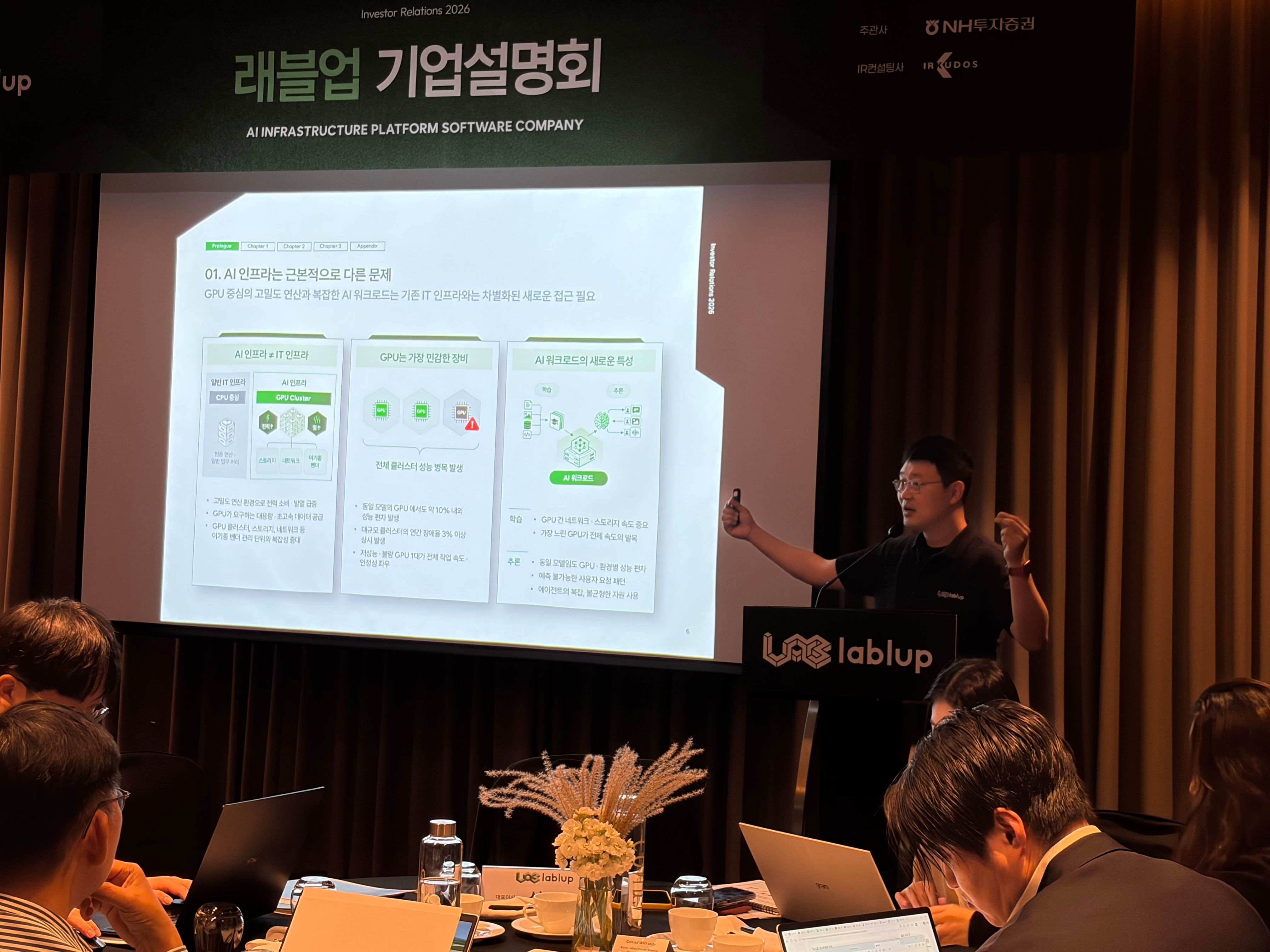
▲ Lablup CEO Jeongkyu Shin presents the company's growth strategy and vision for its planned KOSDAQ listing at the IPO briefing.


