
Lablup Open-Sources Korean Inference Acceleration Model 'GLM-5.2-NVFP4-DFlash-ko' to Mark Hangul Day

SEOUL, South Korea, October 12, 2026 — Lablup has released GLM-5.2-NVFP4-DFlash-ko, an open-source draft model that accelerates large language model (LLM) responses for Korean-language queries and Korean agent workloads. The model was published on Hugging Face on October 9, in celebration of Hangul Day.
The draft model applies the DFlash method released by z-lab and is designed to be used with Z.ai’s open LLM, GLM-5.2, when running in NVIDIA’s 4-bit floating-point format (NVFP4). Developers and enterprises can download the model from Lablup’s Hugging Face repository, lablup/GLM-5.2-NVFP4-DFlash-ko.
A Draft Model Trained for Korean
A draft model is a smaller model used in speculative decoding. It first predicts several upcoming tokens, and the larger model that generates the final response verifies those predictions in a single pass, accepting only the tokens it confirms. Because the larger model makes the final decision, response quality can be maintained while generation speed improves. The more accurate the draft model’s predictions, the greater the acceleration.
DFlash enables the draft model to generate multiple tokens at once rather than predicting them one at a time.
Lablup found that existing draft models trained on English data showed lower prediction acceptance rates for Korean queries and Korean agent tasks than for English-language tasks, reducing their acceleration benefit. To preserve acceleration performance in Korean, Lablup trained the new draft model on Korean data.
Measured using real Korean agent traffic, the model achieved an average accepted length (MAL)—the average number of tokens accepted per verification pass—of 2.71 for agent tasks and 2.77 for Korean queries. This is nearly equivalent to the acceleration performance of an English DFlash model. By contrast, draft models trained on English recorded MAL values in the 1.x range for these Korean workloads.
Lablup’s Model Development Roadmap
Following this release, Lablup is developing a Korean draft model for Z.ai’s GLM-5.3-Flash.
Separately, Lablup is training a Korean diffusion language model from scratch. The model is expected to have approximately 11 billion (11B) parameters and is being developed as an on-device model for agent tasks on local devices. Training is being conducted on a GPU cluster of 64 B200 GPUs, with part of the GPU resources supported by the Ministry of Science and ICT and the National IT Industry Promotion Agency (NIPA) through its Advanced GPU Utilization Support Program.
Jeongkyu Shin, CEO of Lablup, said: “When draft models are trained only on English, Korean users have had difficulty fully benefiting from the acceleration effects of speculative decoding. We are releasing a Korean draft model on Hangul Day so that developers and enterprises building AI services can achieve acceleration benefits in Korean-language environments as well.”
He added, “Building on the experience we have accumulated in developing AI infrastructure software, Lablup is expanding its business scope to include the development of Korean-language models.”
Model Availability
The model is available at:
https://huggingface.co/lablup/GLM-5.2-NVFP4-DFlash-ko
(Released on October 9, 2026)
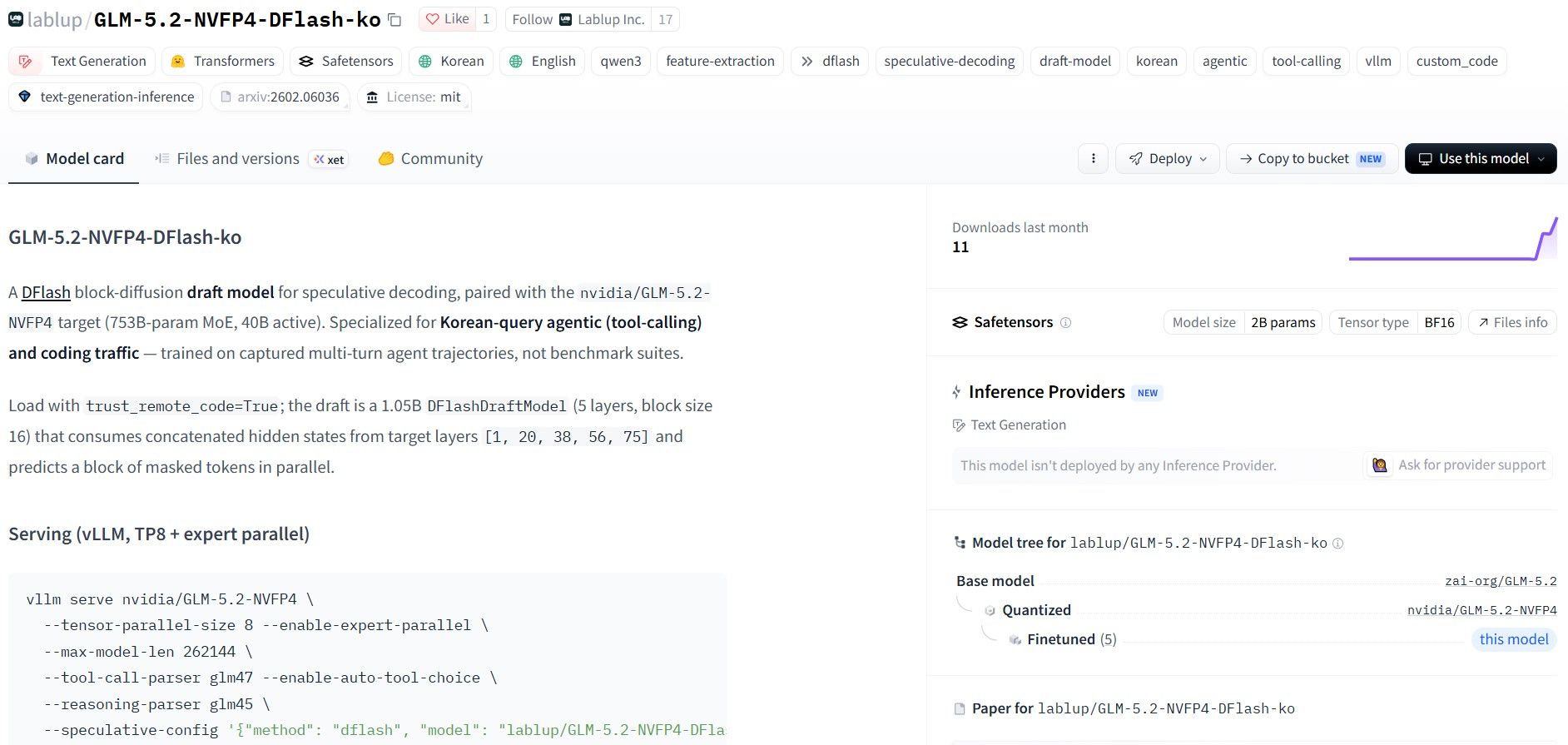
▲ Lablup’s GLM-5.2-NVFP4-DFlash-ko model repository on Hugging Face


